Apollo ID Reservations
Membership Loyalty App
Company: Apollo Technology
Role: User Interface Designer, User Researcher
Duration: July 2021 - August 2022
Scope: User Research, Interface Design
Tool: Figma
Link: Get Apollo App
About
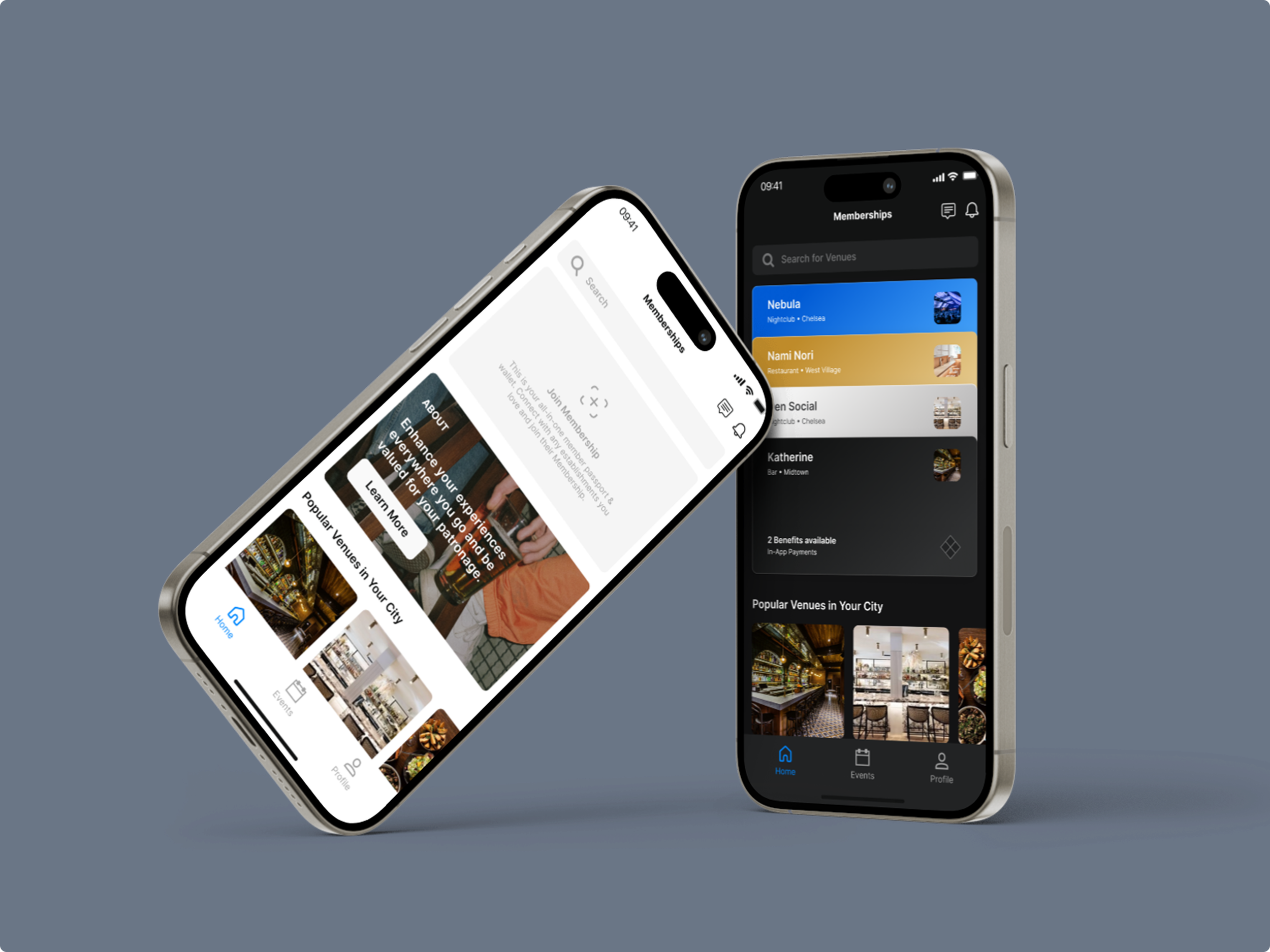
Apollo ID serves as the quintessential venue membership loyalty app, offering a comprehensive overview of its unique two-way benefits. For users, having an Apollo ID account translates into exclusive access to a host of enticing perks from their beloved venues. Simultaneously, Apollo ID empowers venues by providing a powerful platform to extend their outreach to a broader audience.
The platform boasts an extensive and diverse range of partner venues, including restaurants, karaoke lounges, cafes, nightclubs, and bars. Apollo ID membership benefits are diverse, encompassing expedited entry, complimentary appetizers or drinks, enticing buy-one-get-one offers, and much more.
Established in 2021, the app has rapidly expanded its footprint, currently boasting 100+ venue partnerships across the vibrant landscape of New York City. Our ongoing commitment is to continue nurturing our user base and fostering new venue partnerships, with the ultimate goal of becoming your premier destination for exceptional offline experiences. Partner venues efficiently manage their members through our dedicated app, Apollo HQ.
Role
The Apollo ID design team consists of a dynamic duo: myself and my co-designer, Rainey Chak. Taking the lead on this particular feature, I embarked on the design journey, creating initial concepts. Subsequently, I presented these concepts to Rainey and the entire team, encouraging an open dialogue to gather valuable thoughts and feedback.
Challenge
Provide a solution that enables customers to conveniently check table availability and submit reservation requests directly on our venue pages within the app.
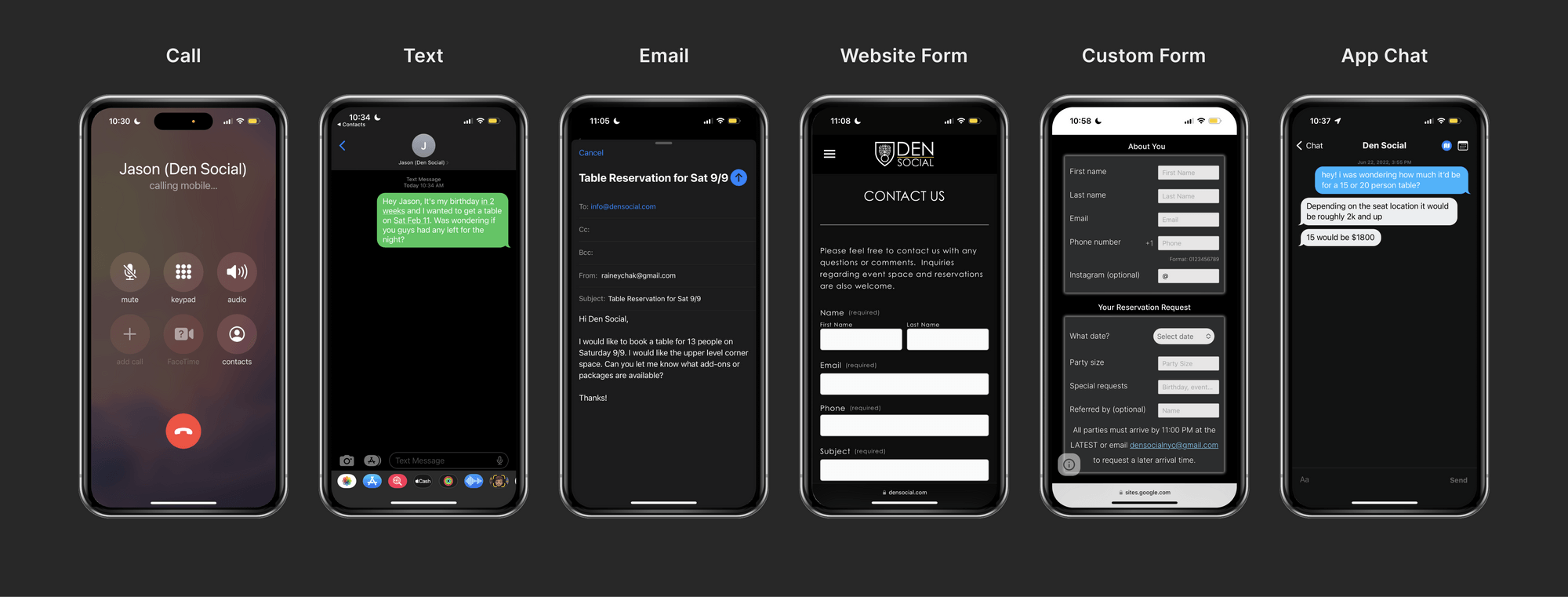
Several of our esteemed bar and nightclub partners have candidly shared one of their most pressing business challenges: the overwhelming influx of table reservation requests, especially in the lead-up to the weekend. This surge in requests arrives through various channels, including phone calls, text messages (if the owner's number is available), emails, website form submissions, messages within Apollo ID's chat, and even in-person inquiries at the venue.
This multitude of communication methods has posed a significant organizational hurdle for venue owners and their staff, making it challenging to provide customers with a streamlined process for checking table availability over the weekend. Consequently, both our venue partners and their patrons have consistently urged us to develop a feature within our app that enables customers to make table reservations directly through the platform. Such a feature would not only alleviate the burden on venues but also simplify the process for customers, eliminating the need to approach venues through various disparate channels.
Solution
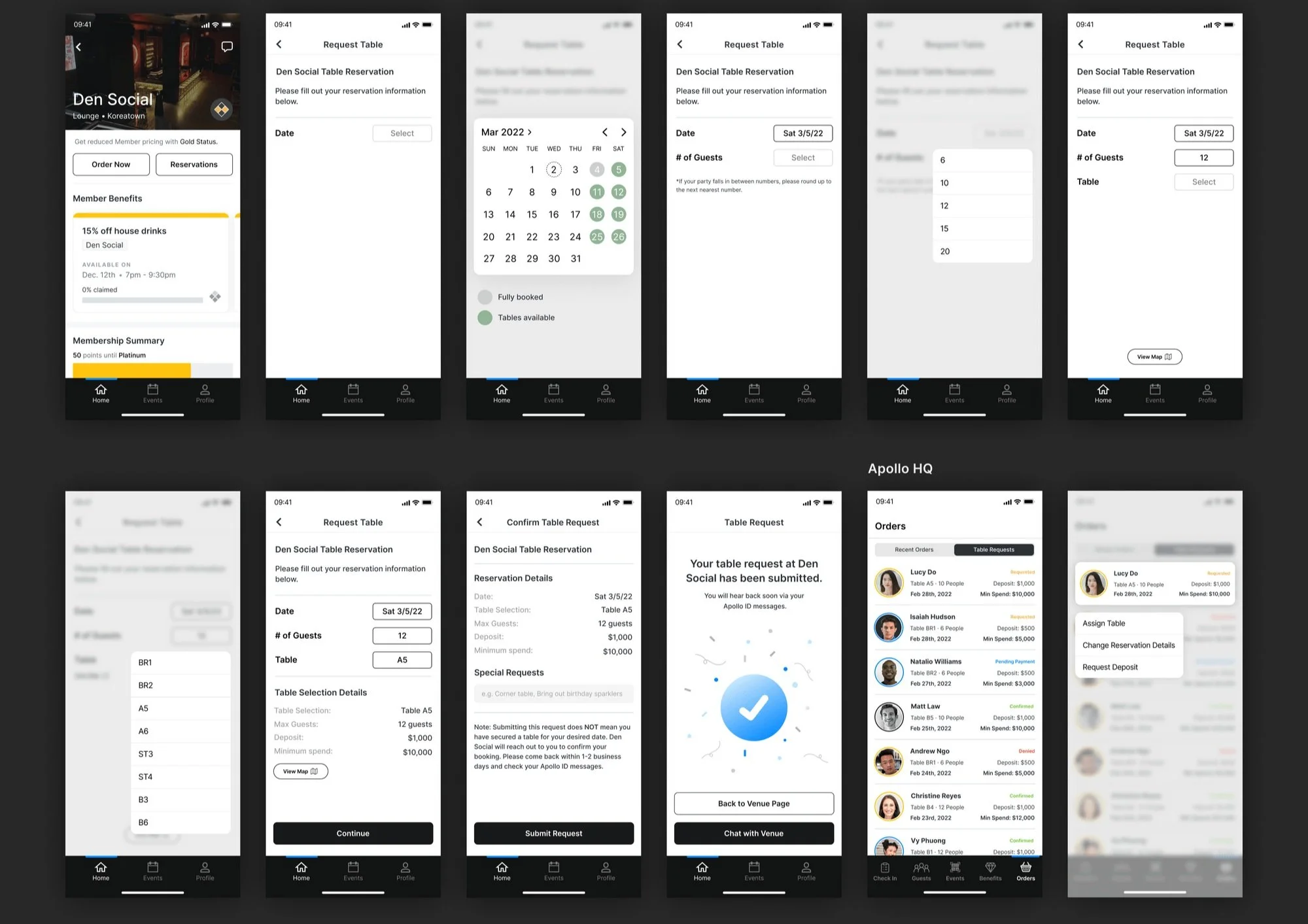
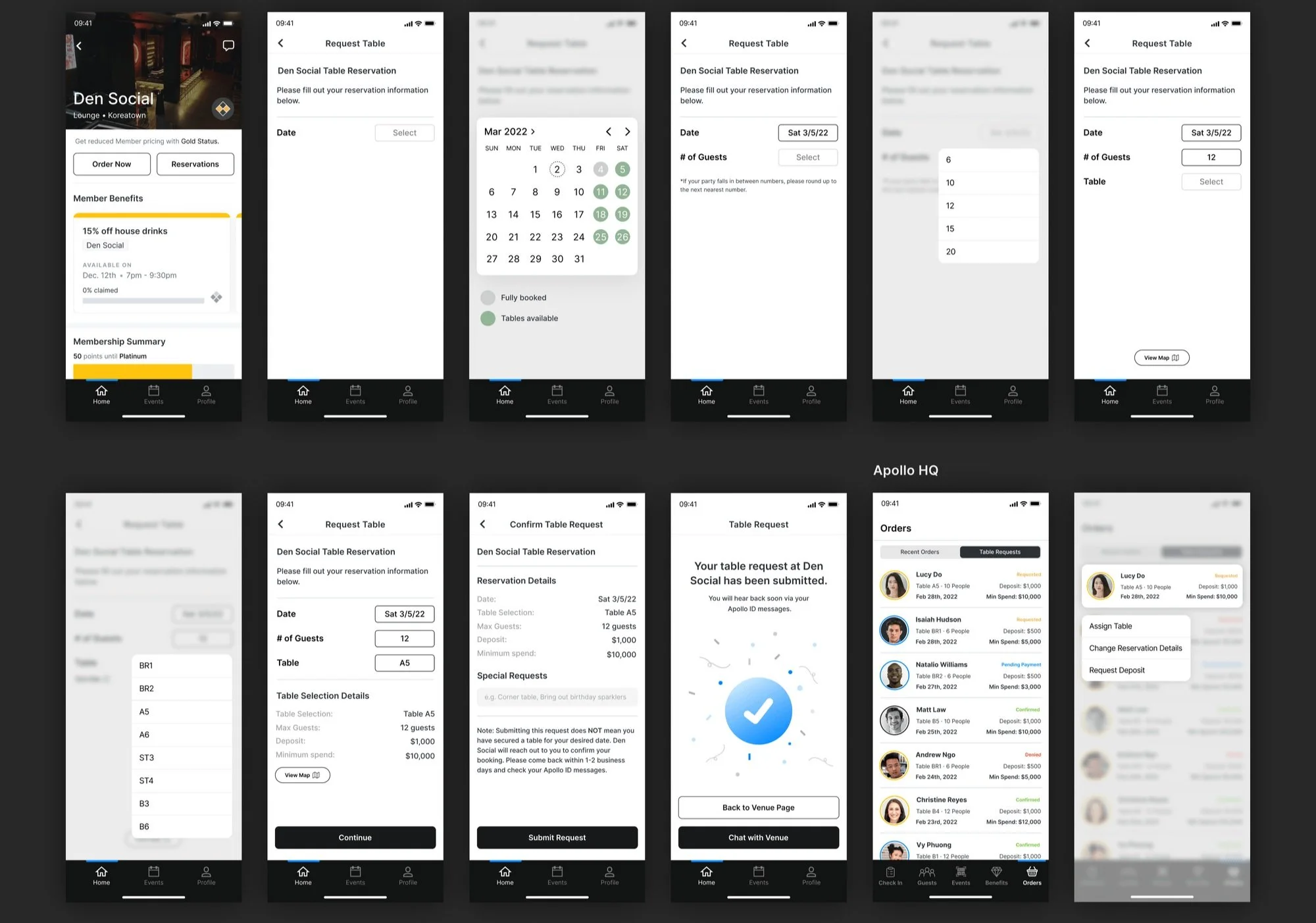
Introducing a reservation feature that enables users to request tables on specific dates, allowing venues to review and take action (approve or deny) on these incoming requests.
For our initial reservation feature launch, we honed in on the specific needs of our bar and nightclub partners, as they appeared to stand the most to gain from such a feature. After delving into the diverse methods through which venues handle reservation requests and their existing procedures, I proceeded to conduct thorough competitive research to gain insights into the functionality of other reservation platforms. Part of the onboarding process in this project involved immersing myself in a comprehensive understanding of the fundamental workings of businesses in the hospitality industry, encompassing restaurants, bars, nightclubs, and more. Engaging in insightful conversations with our venue partners and business owners, it became evident that while each venue operates uniquely, our app's core features should provide a consistent and intuitive experience for customers across all venues.
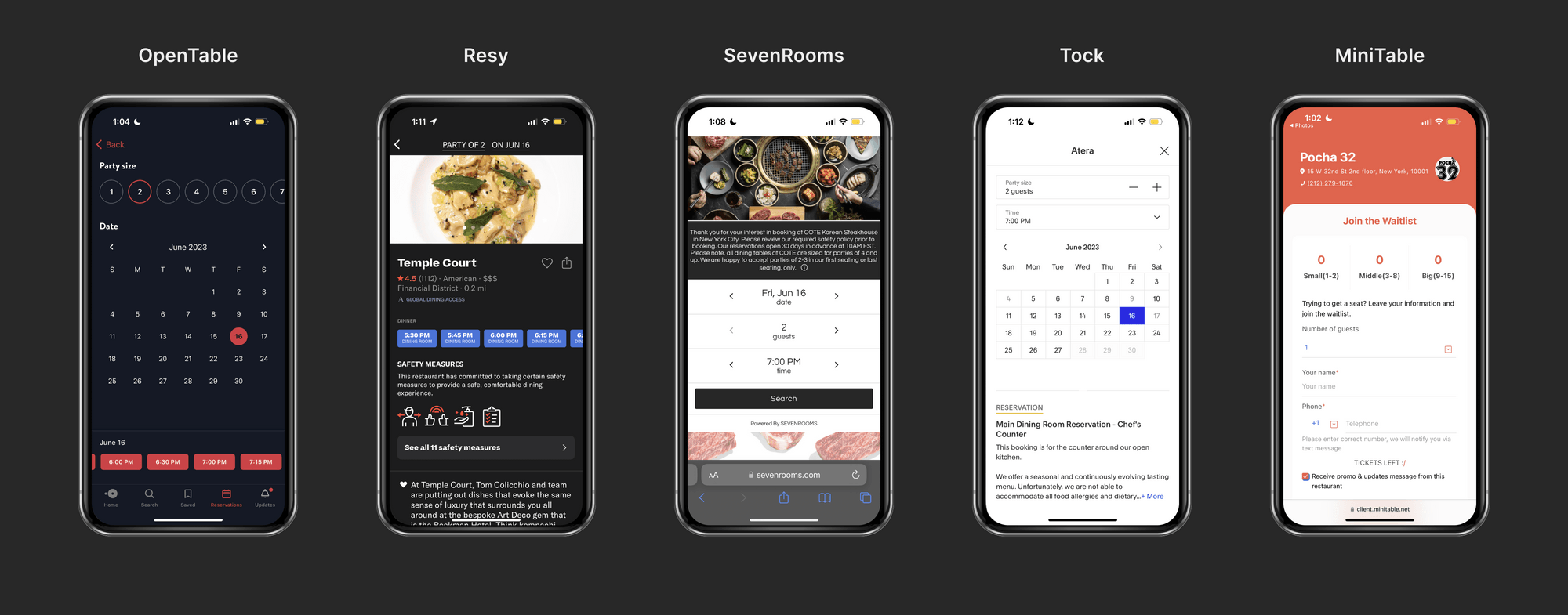
As I delved deeper into my research and engaged in discussions with our Account Executive, who plays a pivotal role in managing our venue partnerships, it became evident that the hospitality industry is saturated with a multitude of competitors and diverse platforms catering to these businesses. Notable names such as OpenTable, Resy, SevenRooms, Tock, and MiniTable are just a few prominent players in this arena, specializing in assisting venues with reservation management.
However, what truly sets Apollo ID apart from our competitors is our unique proposition: not only do users have the convenience of making reservations through our app, but they can also seamlessly place orders directly within it while enjoying exclusive benefits. These are features that set us apart from standalone reservation platforms. Recognizing the need to incorporate a reservation feature, we aimed to position ourselves as the ultimate one-stop solution for our venues' multifaceted business requirements.
The leading reservation platforms share a common functionality, where users input their details and select their desired reservation date and time. Our challenge lay in crafting a mobile-friendly and intuitively designed user experience that seamlessly integrates with the array of features our app offers, ensuring clarity and ease of use amidst a competitive landscape.
User Flow
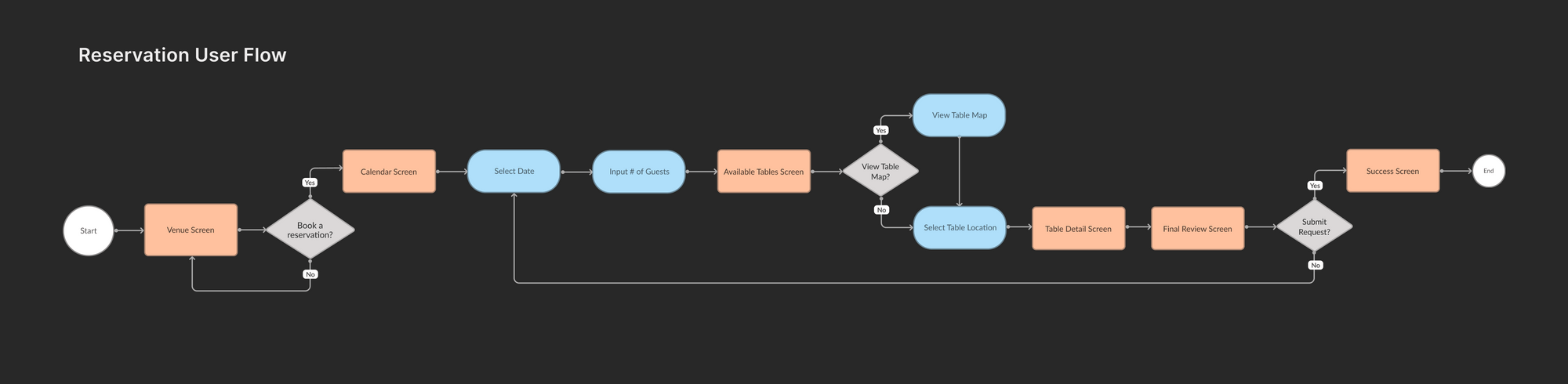
My initial explorations in this project began by outlining the fundamental user flows for the reservation feature. Examining existing reservation platforms and gaining insight into the reservation processes of our partner venues, I identified the essential components required at the foundational level: user input for the number of guests, date and time selection, the ability for users to view available tables after providing their details, deposit information, and a confirmation screen.
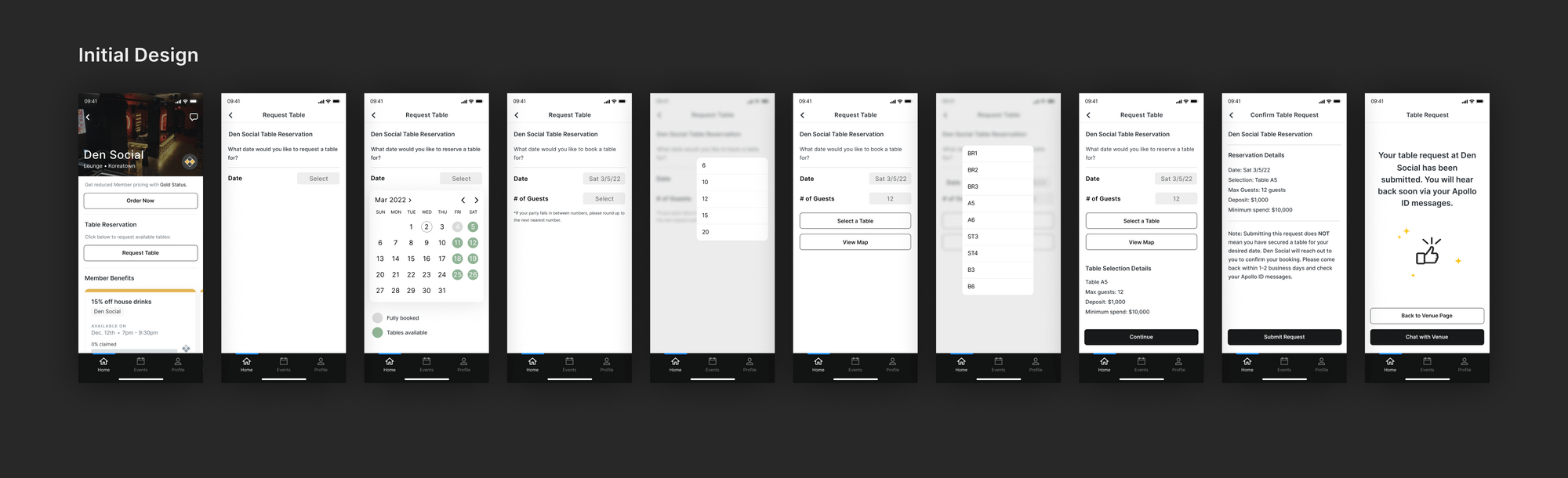
Embracing a mobile-first design philosophy necessitates a constant awareness of the limited screen space at our disposal. In light of this constraint, I envisioned an effective approach for soliciting user information: presenting screens in a step-by-step sequence, thoughtfully organized to avoid overwhelming the user. These sequential screens would encompass the essential elements I previously outlined, including user input for the number of guests, date and time selection, the ability for users to view available tables post-input, deposit details, and a reassuring confirmation screen.
MVP Review
After completing the initial design explorations and establishing the foundational screens, I presented them to the team with the primary goal of mapping out the Minimum Viable Product (MVP) and documenting the core concepts. However, as we delved deeper into discussions and screen reviews, a plethora of questions emerged, each one shedding light on how this feature would impact all stakeholders involved and various facets of the app:
How can guests incorporate notes or comments for their reservations?
What specific member information do we require to uniquely tie and confirm reservations to individuals?
How can all group members at a table easily identify its location?
How can members invite their friends to join them at the table?
What is the communication plan for venues to reach out to members after they've submitted their reservations?
Where in the app will members access information regarding the status of upcoming table reservations?
How should we manage pending reservation requests that have not yet been approved?
Furthermore, from the venue's perspective, we had additional inquiries:
How will staff members access and review reservation requests?
What is the process for staff members to approve reservation requests?
Will we enforce a deposit requirement for members, and how do we handle reservations when members drop or fail to show up at the last minute?
These critical considerations compelled me to think about the app's functionality and implications in ways that exceeded my initial expectations.
MVP Reiteration
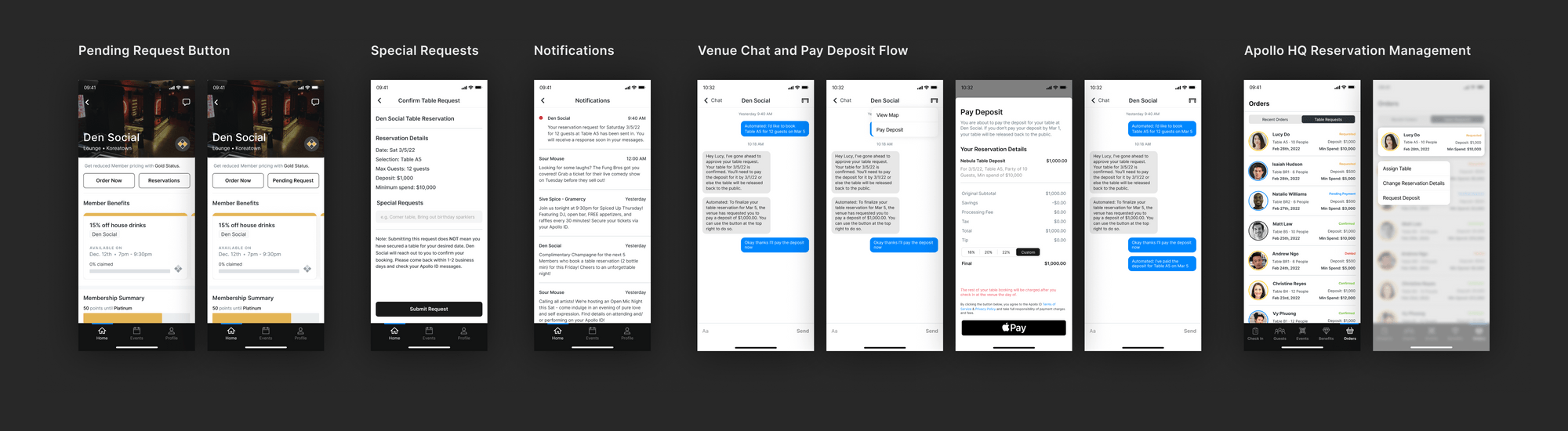
Armed with these critical questions, I embarked on a thorough redesign process to ensure that our design not only addressed these challenges but also offered a seamless user experience, devoid of any major roadblocks hindering users from achieving their goals. I took a closer look at the existing screens, refining them and creating new ones, particularly within our Apollo HQ app, which caters to staff members responsible for managing incoming reservation requests.
On the consumer side, I made substantial enhancements, introducing key elements such as a "pending request" button, an input box for "special requests," the integration of reservations into our existing notification feature, and a streamlined deposit flow. Some complex queries, like the mechanics of adding friends to a table reservation, were intentionally deferred to subsequent iterations, as we exercised caution in expanding the scope of this feature too extensively.
Implementation & Finalized Iteration
Upon reaching the design's finalization stage, I entered into a collaborative phase with our software engineer, who also serves as our CTO, to breathe life into the feature. This collaborative effort encompassed not only the construction of the user interface but also in-depth discussions and decisions regarding the intricacies of how the reservation feature would operate on the backend.
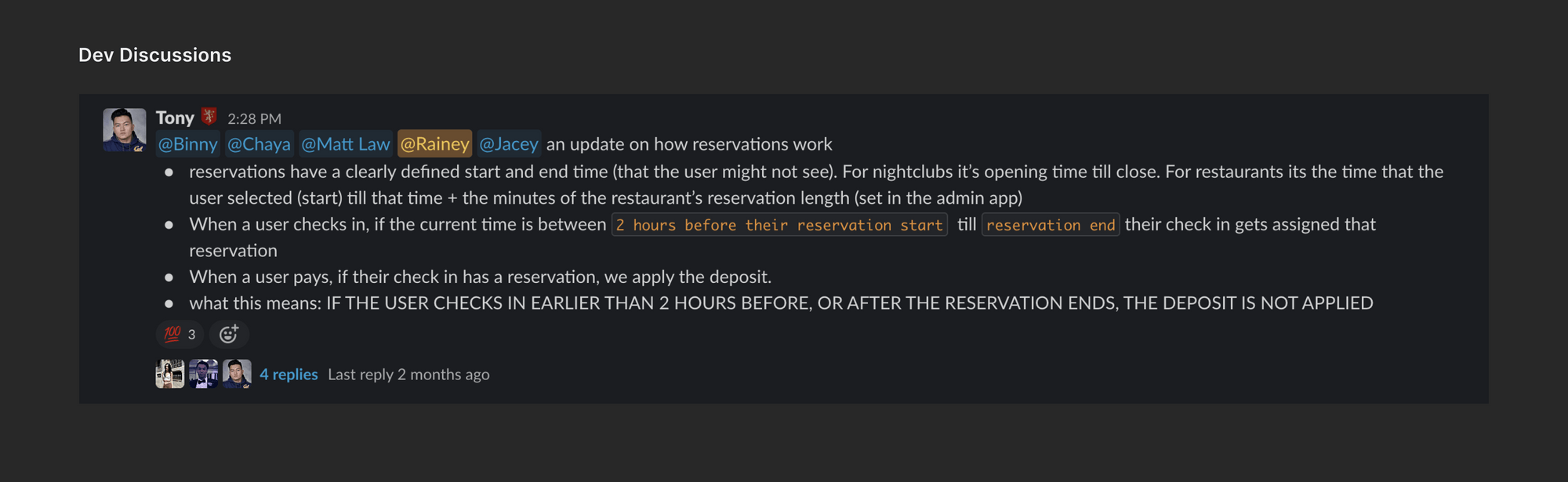
The reservations feature had its inaugural launch in January 2023, initially extending to our bar and nightclub venue partners before expanding to include our restaurant venue partners shortly thereafter. Since its introduction, we have observed a consistent increase in app spending. Notably, in the most recent months of April 2023 and May 2023, member reservations contributed $30,000 and $47,000, respectively, to our app's revenue. Our commitment to tracking this feature's performance remains unwavering, ensuring that ongoing enhancements continue to augment overall user app spending.
While we haven't implemented significant design changes to the user flows since the initial release, we have exciting plans to introduce additional components to this feature in the near future. One such iteration involves integrating our social layer into reservations. For instance, Apollo ID members will soon have the capability to add friends to their existing reservations or split deposits and payments for reservations within the app. We anticipate revisiting and enhancing this feature as our app's social layer becomes more comprehensive and robust.